I think most of you know that 2022 was a very difficult year for me. In February I was told I had cancer in my neck. After surgery, radiation, and chemo, Nancy and I moved into a home in Cabo San Lucas that we had built as part of what we described as our five-year vacation plan.

We were going along until I had emergency disc replacement surgery in my neck in July, followed by bacterial pneumonia that put me on a ventilator for five days, in the hospital two more weeks, losing 40 pounds and being brought to our Cabo home in an ambulance. We sold our home and moved to Fort Worth, where we now live.
I tell you all this because you might be wondering how I have time to write novels. I make the time because my health now limits what I can do. In this blog I want to tell you about one that has consumed me for the last few months.
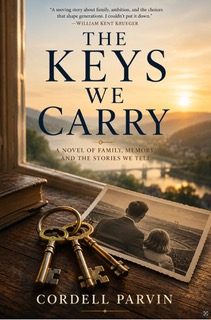
After finishing my last novel, I was at a loss for what, if any, story could write. The Keys We Carry began with a question that came to me while daydreaming. What would my family’s life have been like if we had never left Roanoke?
Nancy and I settled in Roanoke, Virginia, in 1976. We moved from Roanoke to Richmond in 1987, and moved from Richmond to Dallas in 1996. I made each move to further my law career.
Around the same time as that daydream, I found myself thinking about Alan Jackson and his song Remember When. Like so many of his songs, it tells a story. In just a few minutes, he captures decades of marriage, family, children, and the passing of time. Every time I hear it, it reminds me how quickly one season of life becomes another.
I also found myself thinking about Neil Diamond’s I Am… I Said. It asks where we really belong and whether a place can ever completely leave us. Those questions became part of Claire Harlan’s journey as she tries to understand why her father never stopped talking about Knoxville and why the people he loved mattered more than the place itself.
Thinking back to when Nancy and I arrived in Roanoke, while the country was celebrating the 200th anniversary of the, Declaration of Independence, I wanted this novel to explore: how quickly the seasons of our lives pass, how our marriages and families change over time, and how easy it is to look back and wonder where the years went.
Rather than write a memoir, I decided to explore that question through fiction.
Roanoke became Knoxville.
Richmond became Nashville.
Dallas became Houston.
The people and events in this novel are entirely fictional, but the question that inspired the story is real.
Claire Harlan is one of Houston’s most successful construction lawyers. When her father, a retired trial lawyer struggling with dementia, asks to return to Knoxville one last time, she believes she is simply honoring his wish.
Instead, she begins discovering the lives her parents lived long before she was part of them.
As I wrote the novel, I realized I wasn’t really writing about Knoxville. I was writing about something much larger.
- How well do we really know our parents?
- What dreams did they set aside?
- What choices shaped the lives they eventually built?
- And what do we quietly lose while pursuing the success we once believed would make us happy?
The story gradually became as much about Claire’s mother, Margaret, as it did about her father. Claire begins the novel trying to understand why her father never stopped talking about Knoxville. She eventually discovers that what he missed most was never the city itself. He missed the people.
During my nineteen years coaching young lawyers, I encountered talented lawyers working very hard , often struggling to find more time for family, friendships, and the relationships that mattered most. You might recall, I wrote that you will never “find” the time. You have to “make” the time.
I am what’s called a “seat of the pants” writer meaning even when I outline, it’s still subject to change as a write. I wrote at least five or six complete versions of the story. When I finished I was never satisified. So, I’d start over.
At its heart, The Keys We Carry is not a novel about dementia or even about returning home. It is a story about family, marriage, ambition, belonging, and the quiet realization that the people closest to us often have lives we never fully understood.
I hope readers close the book thinking about their own parents, their own children, and the people who quietly shaped their lives. If the novel encourages someone to make one more phone call, visit an aging parent, invite friends to dinner, or simply spend a little more time with the people they love, then I will have accomplished exactly what I hoped this story would do.
A beta reader described my novel as family fiction about memory, relationships, and the choices that shape our lives. I hope that when it is published in a few weeks, you will give The Keys We Carry a try.
⸻